
and Portfolio Strategy
Q3 2026
Private Markets Outlook
Unrelenting macroeconomic, political and geopolitical developments remain a key driving force for the global economy and financial markets alike.
On the financial markets front, an elevated inflation and interest rate environment has reduced the expected returns for both stocks and bonds, in our view – and particularly in light of lofty valuations in the public markets space. In bond markets, both short- and long-term interest rates are expected to settle higher as inflationary risks linger on, leaving little in the way of upside for bond prices. What’s more, there are growing reasons to believe that we are embarking on a period of structurally higher inflation over the next 5 years given secular forces including demographic trends (aging populations), deglobalization, rising fiscal deficits, lingering geopolitical conflicts and imbalances associated with the green energy transition. Structurally higher inflation (and interest rates) suggests that traditional fixed income may fall short of what investors have grown accustomed to over the last several decades. Meanwhile, lingering fears of an equity bubble in the high-flying technology space are looming large should growth (productivity) and earnings fall short of expectations and/or should interest rates remain elevated for longer.
We expect a challenging environment for financial markets in the coming 12-18 months, which poses some notable challenges to a traditional 60/40 portfolio of stocks and bonds. Somewhat worrisome is that government bonds may be less reliable in protecting downside in what could be a volatile financial market environment, bringing into question their traditional role as a safe haven. That outlook underscores the case for private markets strategies that are less exposed to potential macroeconomic or geopolitical shocks. Namely, non-traditional sources of income such as private credit and real assets provide a relatively stable return profile, lower volatility and inflation protection – while private equity has demonstrated an ability to generate equity-like returns with less volatility. In addition to these attractive attributes, their low correlations to traditional asset classes and differentiated sensitivities to the economic cycle provide diversification benefits and a reduction of overall portfolio risk, underscoring the merits of allocating to non-traditional asset classes in the strategic asset allocation.
Portfolio Resiliency and Private Market Strategies
- Universe Bonds
- Private Credit
- Real Assets
- Canadian Equity
- Global Equity
- Private Equity

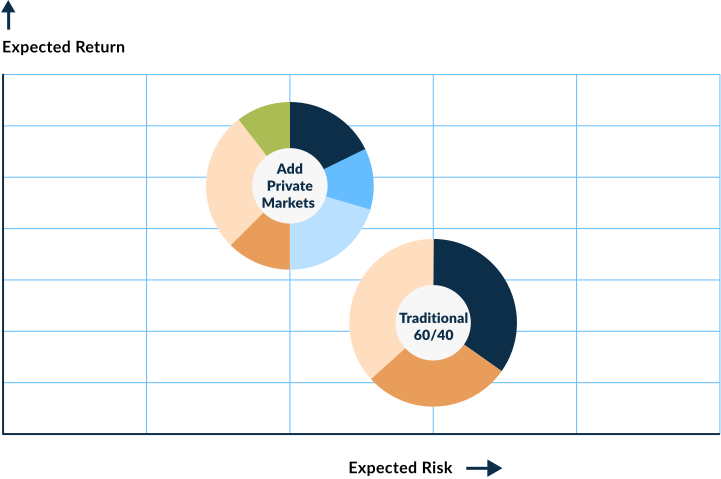
Source: Fiera Capital, for illustrative purposes only.
Private Market strategies continue to be instrumental in the construction of a resilient and well-diversified portfolio. Optimizing a portfolio to include private credit, real assets, and private equity may enhance both the performance and durability of a total portfolio, including maximizing the potential for an increase in its reward per unit of risk.